
What Is the Food Hygiene Rating Scheme?
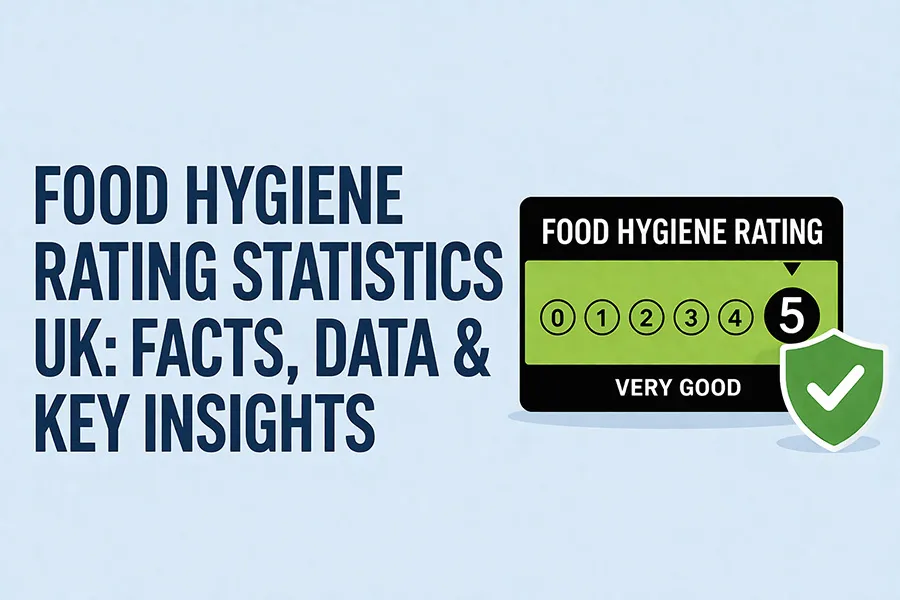
The Food Hygiene Rating Scheme (FHRS) is the UK's primary consumer-facing tool for communicating the hygiene standards of food businesses. Launched by the Food Standards Agency (FSA) in 2010 in partnership with local authorities, the scheme gives food businesses a rating from 0 to 5 following an inspection by a food safety officer. A rating of 5 means hygiene standards are very good; a rating of 0 means urgent improvement is necessary.
In 2025 the scheme celebrated 15 years — a milestone that marks substantial improvements in food hygiene compliance across the UK, even as enforcement capacity has declined and food poisoning cases have risen to decade highs. The data behind the FHRS tells a more complex story than a simple headline of improvement, and this guide brings it all together. For the broader food poisoning context, see our Food Poisoning Statistics UK guide.
These figures are the latest available from official UK statistics, and this page is reviewed and updated as new data is published.
Key Facts & Figures (Overview)
- The FHRS covers more than 430,000 food businesses across England, Wales, and Northern Ireland.
- 78% of businesses are rated 5 (very good) — the top rating.
- 97% of businesses have achieved a rating of 3 (generally satisfactory) or better.
- Since 2013, the proportion of businesses achieving the top rating of 5 has risen by more than 24% — reflecting widespread improvement in food hygiene standards.
- 91% of consumers recognise the distinctive green and black food hygiene rating sticker.
- 89% of consumers have heard of the FHRS.
- 64% of customers consider cleanliness and hygiene when choosing where to eat.
- 82% of customers say they would avoid any takeaway or restaurant with a low hygiene rating.
- Only 36% of consumers say they actively check the food hygiene rating when deciding where to eat out.
- In England, display of the rating is voluntary — resulting in selective non-display by lower-rated businesses.
- In Wales and Northern Ireland, display of the rating is legally mandatory.
- 72% of businesses in England were displaying their FHRS sticker in 2025 — up from 69% in 2023, but still leaving more than a quarter not displaying, compared with 94% display in Wales and 90% in Northern Ireland where display is mandatory.
- Businesses with a rating of 5 are significantly more likely to display (around 80% displaying) compared to businesses with a rating of 3 (only 38% displaying).
- FSA research shows that food businesses rated 2 or below are twice as likely to be linked to food poisoning outbreaks compared with those rated 3 or higher.
- 45% of businesses in England with a top rating of 5 report that displaying it has had a positive impact on their business.
How the Food Hygiene Rating Scheme Works
The FHRS operates through local authority food safety officers (Environmental Health Officers, or EHOs) who inspect food businesses and assess them against three criteria:
Hygienic food handling — how food is prepared, cooked, chilled, and stored, and whether cross-contamination risks are being controlled.
Condition of facilities and building — the physical state of the premises, including cleanliness of surfaces, equipment, and facilities.
Food safety management — whether the business has documented food safety procedures (typically a HACCP system) and whether staff have appropriate food hygiene training.
Each criterion receives a score, and these are combined to produce the overall rating from 0 to 5. The overall rating reflects the element with the lowest score — a business that excels in two areas but fails significantly in one cannot achieve the top rating.
Ratings are published on the FSA's ratings website (ratings.food.gov.uk) and are updated after each inspection. Businesses have a right to appeal their rating and may apply for a re-inspection if they address the issues identified.
The Distribution of Ratings in the UK
The headline figures of 78% rated 5 and 97% rated 3 or above represent substantial progress since the FHRS launched in 2010. However, the aggregate figures mask important variations:
Lower-rated businesses — the proportion of businesses rated 0, 1, or 2 is small but represents a disproportionate public health risk. FSA research confirms that these businesses are twice as likely to be associated with food poisoning outbreaks. The FSA's own surveillance data identifies that analysis shows premises with higher FHRS ratings are less likely to have unsatisfactory microbiological results.
Geographic variation — the FSA's ratings data reveals significant regional variation in compliance. High Speed Training's analysis of FSA data covering over 240,000 businesses identified the London borough of Waltham Forest as having the highest percentage of establishments rated 0–2 in England and Wales as of 2024.
Sector variation — ratings vary substantially across food business types. Takeaways and mobile food vendors tend to have lower average ratings than restaurants and supermarkets, though the pattern is not consistent across regions.
Scotland uses a different system — the Food Hygiene Information Scheme (FHIS) — which uses a binary Pass/Improvement Required rating rather than the 0–5 scale. This means direct comparison with FHRS ratings is not possible.
The Display Gap in England
One of the most significant ongoing policy debates around the FHRS concerns the mandatory display of ratings. In Wales and Northern Ireland, businesses have been legally required to display their rating prominently since 2013 and 2016 respectively. In England, display remains voluntary — a situation the FSA, the Chartered Institute of Environmental Health (CIEH), and numerous consumer organisations have long called on the government to change.
The practical consequence of voluntary display in England is predictable and well-documented:
- 72% of businesses in England displayed their rating in 2025 — leaving over a quarter not displaying
- Businesses with a rating of 5 display at a rate of approximately 80%
- Businesses with a rating of 3 display at a rate of only 38%
- Businesses with lower ratings are systematically less likely to display — meaning the voluntary scheme functions effectively as a self-selection mechanism that withholds the most safety-relevant information from consumers
An FSA survey found that more than four in five businesses in England (80%+) support the introduction of mandatory display — including many who are already displaying voluntarily and would see no change in practice. Despite this broad business support and the clear public health case, mandatory display in England had not been legislated as of 2026.
The Welsh experience is instructive: compliance with mandatory display in Wales reached 94% in 2025 (with Northern Ireland at 90%), and consumer awareness and use of the scheme is higher in Wales than in England — reflecting the difference that mandatory display makes to the scheme's effectiveness as a public health tool.
Consumer Awareness and Behaviour
FSA research tracks consumer awareness and behaviour in relation to the FHRS annually:
- 89% of consumers have heard of the FHRS
- 91% recognise the distinctive food hygiene rating sticker
- 46% of consumers say they look for food hygiene ratings "always" or "most of the time" when choosing where to eat or buy food
- 36% say they would consider the food hygiene rating when deciding where to eat out during December and the festive period
- 64% say cleanliness and hygiene is a factor in their choice of where to eat
- 82% say they would avoid a takeaway or restaurant with a low hygiene rating
The gap between stated intention (82% would avoid low-rated businesses) and actual behaviour (36% check ratings before eating out) reflects a pattern common across food safety behaviour — awareness of risk does not automatically translate into behaviour change at the point of decision. The FSA's "Look Before You Book" campaign launched in November 2025 directly targets this intention-behaviour gap.
What Drives Food Hygiene Ratings
The FSA's ratings data and local authority enforcement reports identify the most common reasons businesses fail to achieve high ratings or are given improvement notices:
Inadequate food safety management systems — the absence of documented HACCP procedures, records of temperature checks, or cleaning schedules is one of the most frequent reasons for low ratings.
Poor temperature control — food stored or served at incorrect temperatures is among the most common compliance failures, particularly in businesses without adequate refrigeration capacity or where staff lack knowledge of temperature requirements.
Cross-contamination risks — inadequate separation of raw and ready-to-eat foods, shared equipment without sufficient cleaning between uses, and inadequate allergen management are persistent issues.
Poor personal hygiene — inadequate handwashing facilities, lack of handwashing training, and food handlers returning to work before 48 hours after diarrhoea or vomiting symptoms are well-documented risk factors.
Inadequate cleaning — unclean surfaces, equipment, and premises were the most common food law breach recorded in early FSA prosecution data — accounting for 26% of cases.
Pest control failures — evidence of pest activity at food premises is a serious compliance failure that results in both regulatory action and the risk of contamination of food products.
The Business Case for a High Rating
Beyond regulatory compliance, a high food hygiene rating has demonstrable commercial value:
- 45% of food businesses in England with a rating of 5 report that displaying it has had a positive impact on their business — attracting customers who actively seek out high-rated premises.
- In Wales and Northern Ireland, where display is mandatory, 56% of businesses report a positive business impact from their rating.
- A poor rating, by contrast, damages reputation and can significantly reduce footfall. The fact that 82% of consumers say they would avoid a business with a low rating translates directly into measurable revenue impact for businesses with ratings of 0–2.
- Businesses operating food delivery through aggregator platforms (Deliveroo, Uber Eats, Just Eat) face increasing scrutiny of their hygiene ratings. Major platforms have implemented minimum rating requirements, effectively excluding businesses with very low ratings from these growing revenue channels.
Local Authority Enforcement Capacity
The food hygiene ratings system is only as effective as the inspection regime that underpins it. Multiple reports from the FSA, the CIEH, and Food Standards Scotland have raised concerns about the adequacy of local authority food safety enforcement capacity:
- The number of food standards officers in the UK has fallen by approximately 45% over the past decade due to local authority budget constraints.
- There is a substantial backlog of new food businesses awaiting their first inspection — meaning businesses can operate for extended periods without receiving a rating.
- Local authority food sampling rates fell by 4.5% between 2022/23 and 2023/24, from 43,579 to 41,624 samples — substantially below pre-pandemic levels.
- Reduced inspection frequency means ratings may not reflect current conditions at food businesses — a business that received a high rating two years ago may have deteriorated without any subsequent inspection.
The FSA has acknowledged these concerns and is working with local authorities on a risk-based delivery model that focuses enforcement resource on the highest-risk businesses. But the underlying resource constraint remains a structural challenge for the effectiveness of food safety regulation in the UK.
Written by Food Safety Experts
This guide was produced by the team at Food Hygiene Certificate, a UK provider of RoSPA-approved online food hygiene training. Achieving and maintaining a high food hygiene rating requires that everyone handling food understands the hygiene principles underpinning the scheme. Our Level 1, 2, and 3 food hygiene courses are designed to give food handlers, supervisors, and managers exactly that foundation. For the broader food safety data landscape, see our Food Poisoning Statistics UK guide and our dedicated pathogen guides covering Campylobacter, Salmonella, E. coli, Norovirus, Listeria, and Allergen Incidents.
Sources & References
- FSA – Food Hygiene Rating Scheme: 15 Years (2025)
- FSA Research and Evidence – FHRS Audit of Display and Business Survey 2024
- UK Food Security Report 2024: Theme 5 – Food Safety
- Food Safety News – Upward Trend of Hygiene Rating Display Continues in England (2025)
- High Speed Training – Food Hygiene Report 2025
Food safety is preventable with the right training. Our RoSPA-accredited courses start at £13.99 with an instant certificate.
Browse courses → ← All articles