
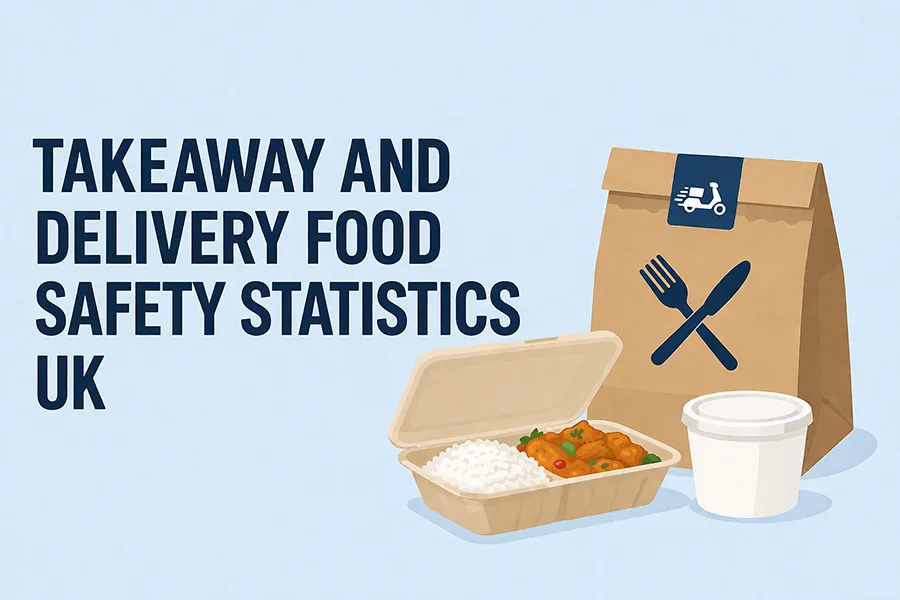
Takeaways and Food Safety: A Growing Risk Landscape
The UK takeaway and food delivery sector has undergone a dramatic transformation over the past decade. The growth of third-party delivery platforms — Deliveroo, Uber Eats, Just Eat — has created an enormous new channel for food consumption that has expanded the volume of meals prepared and delivered by commercial kitchens, while also introducing new food safety challenges: additional handling steps, longer food holding times, ghost kitchens operating without public premises, and the difficulty of extending food hygiene oversight to an increasingly fragmented supply model.
Takeaways are the second most significant setting for foodborne norovirus transmission after eating out, and the proportion of the UK diet attributable to food delivery has grown substantially in the decade since the major platforms launched. For the broader food poisoning context, see our Food Poisoning Statistics UK guide.
These figures are the latest available from official UK statistics, and this page is reviewed and updated as new data is published.
Key Facts & Figures (Overview)
- Takeaways account for an estimated 26% of all foodborne norovirus cases in the UK — the second largest single food transmission route after eating out (37%).
- Between 44% and 85% of all foodborne illnesses in the UK are attributed to food services including restaurants and takeaways collectively.
- The UK Food Hygiene Rating Scheme covers takeaways and delivery businesses — 78% of all food businesses hold a rating of 5, though takeaway-sector compliance is variable.
- 82% of consumers say they would avoid a takeaway with a low food hygiene rating.
- Only 36% of consumers actively check food hygiene ratings before ordering — creating a significant information gap, particularly for online delivery platforms where ratings may not be prominently displayed.
- FSA research found that eating out accounts for 37% of foodborne norovirus cases and takeaways 26% — the two categories together responsible for nearly two-thirds of all foodborne norovirus.
- Oysters carry the highest per-serving risk of norovirus of any food, with an estimated 1 infection per 160 portions — a significant concern for sushi and seafood delivery operations.
- Ghost kitchens — commercial kitchens operating solely for delivery without a physical restaurant — are a growing segment with limited public visibility and variable food hygiene oversight.
- An infected food handler in a takeaway kitchen can contaminate dozens or hundreds of meals during a single shift — the physical distance between preparation and consumption means illness may not be traced back to the source for days or weeks.
Takeaways as a Food Poisoning Setting
Research consistently identifies takeaways alongside restaurants as the primary commercial settings for foodborne illness transmission. The FSA's Norovirus Attribution Study identified takeaways as responsible for 26% of all foodborne norovirus — reflecting the central role of food handler contamination in norovirus transmission through ready-to-eat food.
The characteristics that make takeaway kitchens particularly hazardous include:
- Ready-to-eat food handled extensively after cooking — unlike restaurant plating, takeaway packing involves multiple handling steps after cooking is complete. Each touch of food by a food handler is a potential contamination event.
- Time pressure and high volume — peak delivery windows on Friday and Saturday evenings can see takeaway kitchens preparing many hundreds of meals in a compressed timeframe. Time pressure is a known risk factor for hygiene shortcuts.
- Temperature management during delivery — hot food must be maintained above 63°C throughout delivery; cold food must be kept below 8°C. Extended delivery times — particularly in high-demand periods when demand exceeds driver capacity — create temperature management challenges. The responsibility for delivery temperature lies with the food business, not the platform.
- Allergen communication — customers ordering through delivery platforms may not receive accurate allergen information. Platform menus may not be updated when recipes change, and verbal allergen communication — now required under Owen's Law — is practically difficult in a delivery-only model.
- Ghost kitchens and unregistered operators — the rapid growth of ghost kitchens and the ease with which new delivery accounts can be established on major platforms has created a category of food operator with limited regulatory visibility. All food businesses — including ghost kitchens — are legally required to register with their local authority. However, enforcement of this requirement across the growing delivery sector is challenging.
Food Hygiene Ratings and Takeaways
The Food Hygiene Rating Scheme provides the most accessible data on takeaway compliance. The FHRS covers takeaways alongside restaurants, cafes, and other food businesses, and ratings are available on the FSA's ratings website.
Major delivery platforms have introduced minimum rating requirements that effectively create a commercial incentive for hygiene compliance in addition to the regulatory requirement. However, the relationship between platform requirements and actual consumer information is imperfect:
- In England, display of ratings is voluntary — takeaways may not display their rating at their premises
- Platform apps vary in how prominently they display food hygiene ratings — some show them clearly; others make them difficult to find
- Ghost kitchens and delivery-only operations have no physical premises where a rating sticker would be visible to passing customers
The FSA's 2024 survey found that among businesses using online delivery aggregators, awareness of platform requirements around ratings was increasing — but implementation remained inconsistent.
Allergen Risks in Takeaways
Allergen management in takeaways presents particular challenges:
- Multiple menus and platforms — takeaways may operate simultaneously on multiple delivery platforms with menus that can become out of sync with actual kitchen practices. A customer ordering through one platform may receive different information about allergens than a customer ordering through another.
- Language and communication barriers — the takeaway sector employs a diverse workforce, and language barriers can create difficulties in allergen communication both within the kitchen and between kitchen staff and the customer.
- Cross-contamination in shared kitchen spaces — ghost kitchens often operate multiple menus (sometimes for different brand names) from a single kitchen space, increasing the complexity of allergen segregation.
- Owen's Law compliance — food businesses must now communicate allergen information verbally to customers on request. In a delivery-only model, this means ensuring phone and online ordering systems allow customers to raise allergen queries and receive accurate, personalised responses.
The 2024 peanut contamination in mustard powder — which required recalls from brands including Papa John's — illustrates how allergen contamination in a commonly used ingredient can cascade rapidly through the takeaway and delivery food chain. For full allergen data, see our Allergen Incident Statistics UK guide.
Norovirus and the Food Handler Risk
Norovirus is the single most significant food safety risk in the takeaway and delivery sector, because its primary transmission route through food is via infected food handlers contaminating ready-to-eat food. Key facts:
- Alcohol hand sanitiser does not kill norovirus — only thorough soap-and-water handwashing is effective
- The infectious dose is as few as 18 viral particles — making contamination from a single lapse in handwashing sufficient to cause illness
- A single infected food handler can contaminate dozens or hundreds of meals during a single shift
- The 48-hour post-symptom exclusion requirement applies equally in takeaway settings as in restaurants — but enforcement is particularly difficult in a sector with high staff turnover, gig-economy employment models, and staff who may lose income when they cannot work
Regulatory Requirements for Takeaway Operators
Takeaway businesses — including ghost kitchens and delivery-only operations — must comply with the full range of food safety legislation:
- Registration with the local authority — all food businesses must register with their local Environmental Health department at least 28 days before opening. Failure to register is a criminal offence.
- Food hygiene rating inspection — all registered businesses will be inspected and rated. Ghost kitchens that have registered will receive a rating; unregistered operations will not.
- HACCP food safety management — documented hazard analysis and critical control points covering all food preparation processes.
- Food handler training — all staff handling food must have received appropriate food hygiene training. Level 2 is the standard requirement for food handlers in commercial takeaway kitchens.
- Allergen management — full allergen information for all dishes must be available, and Owen's Law requires verbal communication of allergen information to customers on request.
- Temperature management — food must be cooked to 75°C, hot-held above 63°C, and cold food held below 8°C. Delivery packaging and logistics must be capable of maintaining these temperatures throughout delivery.
What Consumers Can Do
Consumers ordering from takeaways and delivery platforms can take practical steps to reduce their food poisoning risk:
- Check food hygiene ratings before ordering — search the FSA's ratings.food.gov.uk or the equivalent platform feature before placing an order
- Raise allergen queries directly — under Owen's Law, takeaways must communicate allergen information on request; contact the business by phone if the platform doesn't provide adequate information
- Order promptly — do not let delivered food sit at room temperature; hot food should be eaten promptly after delivery, and leftovers should be refrigerated within two hours
- Avoid high-risk foods in delivery — raw fish, shellfish, and dishes involving lightly cooked eggs carry elevated risk in a delivery context where temperature maintenance is more difficult
Written by Food Safety Experts
This guide was produced by the team at Food Hygiene Certificate, a UK provider of RoSPA-approved online food hygiene training. Our Level 2 Food Hygiene Certificate is the standard qualification for food handlers in takeaway and delivery kitchens, and our courses are accessible online — making them practical for the diverse, often high-turnover workforce in the delivery food sector. For the broader food poisoning picture see our Food Poisoning Statistics UK guide, and for pathogen data see our Norovirus, Campylobacter, and Allergen Incidents guides.
Sources & References
- FSA – Foodborne Disease Policy Overview
- FSA – FSA Research Suggests New Higher Estimates for the Role of Food in UK Illness
- FSA – Food Hygiene Rating Scheme: 15 Years (2025)
- PLOS One – Estimating the Prevalence of Food Risk Increasing Behaviours in UK Kitchens
- UK Food Security Report 2024: Theme 5 – Food Safety
Food safety is preventable with the right training. Our RoSPA-accredited courses start at £13.99 with an instant certificate.
Browse courses → ← All articles