
Allergens and Food Safety: Why This Matters
Food allergy is a major and growing public health issue in the UK. Unlike most food safety risks — where contamination is accidental and invisible — allergen incidents frequently involve failures in labelling, communication, or food preparation that make specific foods dangerous for people with diagnosed conditions. The consequences of allergen incidents can be fatal, and the UK has experienced a series of high-profile deaths that have directly shaped the country's food labelling legislation.
The legal and regulatory landscape for allergen management changed fundamentally on 1 October 2021 with the introduction of Natasha's Law — legislation that expanded mandatory ingredient labelling requirements for pre-packed for direct sale (PPDS) foods. This was followed in 2024 by Owen's Law, which requires food businesses to communicate allergen information verbally to customers. Together these reforms represent the most significant change to food allergen law in a generation.
This guide brings together the latest UK statistics on allergen reactions, hospitalisations, deaths, and the food business compliance landscape. For the broader context of food safety in the UK, see our Food Poisoning Statistics UK guide.
These figures are the latest available from official UK statistics, and this page is reviewed and updated as new data is published.
Key Facts & Figures (Overview)
- An estimated 2 million people in the UK have a diagnosed food allergy.
- A further estimated 6 million people experience food intolerance.
- 1 in 5 people in the UK reports some form of adverse reaction to food.
- Approximately 5–8% of children in the UK have a food allergy — one of the highest rates in the world.
- Food allergy rates in UK children increased by 5% per year throughout the 2000s and 2010s.
- Approximately 20,000 people are admitted to hospital in the UK each year following allergic reactions, including those to food.
- The number of hospital admissions for food anaphylaxis more than tripled between 1998 and 2018.
- Around 10 people die every year in the UK from food-induced anaphylaxis — the most severe allergic reaction.
- Peanuts and tree nuts account for the majority of fatal and near-fatal food anaphylaxis cases.
- The Food Standards Agency has identified 14 major allergens that must be declared on food labels and communicated in food service.
- Natasha's Law (October 2021) expanded mandatory ingredient labelling to PPDS foods following the death of Natasha Ednan-Laperouse from an undeclared sesame allergen in a Pret à Manger baguette.
- Owen's Law (2024) requires food businesses in England to communicate allergen information verbally to customers with allergies, following the death of Owen Carey from undisclosed buttermilk in a Byron restaurant burger.
- The FSA estimates that approximately 1 in 100 catering menus contains an undeclared allergen risk at any given time.
The Scale of Food Allergy in the UK
Food allergy is a growing public health concern that now affects a significant proportion of the UK population:
Prevalence: Around 2 million people in the UK have a formally diagnosed food allergy — a condition where the immune system produces an abnormal response to a specific food protein, potentially causing immediate and serious symptoms. A much larger group — estimated at 6 million — experience food intolerance, which involves a different (non-immune) mechanism and is generally not life-threatening but can cause significant ongoing symptoms.
Children: Food allergies disproportionately affect children, with an estimated 5–8% of UK children affected — among the highest rates in the developed world. The most common childhood food allergies are to milk, eggs, peanuts, tree nuts, wheat, and soya. Many children outgrow allergies to milk and eggs; peanut and tree nut allergies tend to be lifelong.
Trends: Food allergy rates in children increased by approximately 5% per year throughout the 2000s and 2010s. The reasons for this sustained increase are not fully understood but are thought to include changes in diet, reduced early allergen exposure, microbiome changes, and environmental factors. Allergy rates have now plateaued somewhat in the most recent years, but the UK still has among the highest food allergy prevalence of any country.
Hospital Admissions for Food Allergy
NHS data provides the most detailed picture of the severe end of the food allergy burden in the UK:
- Hospital admissions for anaphylaxis — the most severe allergic reaction — from all causes (food, medication, insect stings) numbered in the thousands per year in the UK, with food accounting for a significant proportion
- Food anaphylaxis admissions more than tripled between 1998 and 2018, according to published NHS data analysis
- Admissions for food anaphylaxis showed the steepest increase in children and young people — the group with the highest prevalence of food allergy
- Despite increasing admission rates, mortality from food anaphylaxis has not increased at the same rate — reflecting improvements in emergency treatment and increasing availability of adrenaline auto-injectors
The overall picture is one of increasing burden at the severe end: more people with food allergies, more experiencing anaphylaxis, and more requiring hospital treatment — even as clinical management has improved enough to keep mortality broadly stable.
Deaths from Food-Induced Anaphylaxis
Approximately 10 people die every year in the UK from food-induced anaphylaxis — a figure that has remained broadly stable over the past two decades despite the increase in food allergy prevalence. This stability reflects improved emergency management and wider access to adrenaline auto-injectors rather than a reduction in the underlying risk.
The foods responsible for the majority of fatal food anaphylaxis cases in the UK are:
- Peanuts and tree nuts — together responsible for the majority of fatal food anaphylaxis cases. Peanut and tree nut allergies are typically lifelong and among the most potent triggers for anaphylaxis.
- Sesame — responsible for the death of Natasha Ednan-Laperouse in 2016, which directly led to Natasha's Law. Sesame has since been added to the 14 major allergens requiring mandatory declaration.
- Milk — primarily affects children, with dairy-induced anaphylaxis a significant cause of food-related deaths in young people.
- Fish and shellfish — more common causes of severe reactions in adults.
The deaths that have attracted the most public attention — Natasha Ednan-Laperouse (sesame, 2016), Owen Carey (buttermilk/milk, 2017), and Meera Bhatt (sesame, 2018) — all involved failures of allergen communication in food service settings. These cases have been the direct legislative drivers of Natasha's Law and Owen's Law.
Natasha's Law: What Changed in 2021
Natasha's Law — formally the Allergen Labelling Regulations 2021 — came into force on 1 October 2021, extending mandatory full ingredient and allergen labelling to pre-packed for direct sale (PPDS) foods. PPDS foods are those packaged on the premises where they are sold before a customer selects them — sandwiches, wraps, salads, pastries, and similar items prepared and wrapped in advance.
Before Natasha's Law, PPDS foods were in a labelling grey area — not required to carry full ingredient information, only to display allergen information "on request." Natasha Ednan-Laperouse's family argued — and the government ultimately accepted — that this gap allowed sesame seeds in a Pret à Manger baguette to go undisclosed, contributing to her death.
What Natasha's Law requires:
- PPDS foods must carry a label showing the name of the food and a full ingredient list with allergens emphasised (typically in bold)
- This applies to food businesses of all sizes producing PPDS food
- It covers every product prepared and pre-wrapped on the premises before sale
Impact on food businesses: Natasha's Law required substantial investment in labelling systems, ingredient tracking, and staff training across the food sector. Every café, bakery, sandwich shop, and catering operation producing PPDS food was required to review every product and implement compliant labelling by October 2021.
Owen's Law: The 2024 Development
Following the death of Owen Carey — who died in 2017 after consuming buttermilk in a Byron restaurant burger that was not disclosed as containing milk — his family campaigned for further legislative change to require food businesses to communicate allergen information verbally to customers.
Owen's Law was passed in 2024, requiring food businesses in England to ensure that customers with food allergies are made aware of allergen information verbally when ordering, rather than relying on menus or printed information alone. The law specifically addresses the gap where a customer asks about allergens, is directed to a menu without adequate information, and is not offered any further assistance.
The law requires:
- Food businesses to have a system for communicating allergen information to customers upon request
- Staff to be able to signpost customers to allergen information or a person who can provide it
- Businesses not to provide misleading allergen information
Owen's Law represents recognition that labelling alone is insufficient — allergen management requires trained, knowledgeable food handlers who can engage with customers' specific needs.
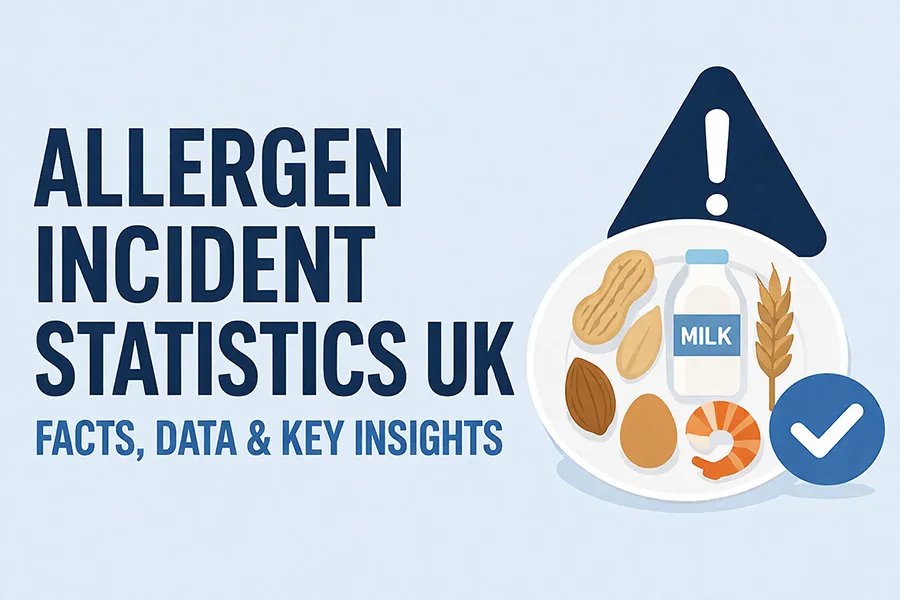
The 14 Major Allergens
UK food law requires the following 14 allergens to be declared on food labels and communicated in food service when present as ingredients:
- Celery
- Cereals containing gluten (wheat, rye, barley, oats)
- Crustaceans (prawns, crab, lobster)
- Eggs
- Fish
- Lupin
- Milk
- Molluscs (mussels, oysters, squid)
- Mustard
- Peanuts
- Sesame
- Soybeans
- Sulphur dioxide and sulphites (above 10mg/kg)
- Tree nuts (almonds, hazelnuts, walnuts, cashews, pecans, Brazil nuts, pistachios, macadamia nuts, Queensland nuts)
Sesame was added to this list relatively recently, following the growing recognition of its role in serious allergic reactions — including the death of Natasha Ednan-Laperouse.
Allergen Incidents in the Food Industry
The FSA monitors allergen incidents through its food alerts and product recall system. Allergen-related food recalls are among the most frequent categories of food safety incident in the UK:
- Undeclared allergens account for a substantial proportion of all FSA food alerts and product withdrawals
- The most common undeclared allergen in product recalls is milk, followed by gluten, nuts, and eggs
- Incidents arise from multiple causes: labelling errors, ingredient substitution without label update, cross-contamination during production, and incorrect reformulation
The FSA's estimate that approximately 1 in 100 catering menus contains an undeclared allergen risk reflects the challenge of managing allergen information across complex, frequently changing menus in busy food service environments.
Allergen Management for Food Businesses
Food businesses have legal obligations under both food labelling and food safety law to manage allergens effectively. The key requirements are:
Know your ingredients — maintain complete and up-to-date ingredient information for every product sold, including all supplier ingredients. Update records when recipes or suppliers change.
Label PPDS foods correctly — under Natasha's Law, all pre-packed for direct sale food must carry a full ingredient list with allergens emphasised.
Communicate allergens in service — under Owen's Law, food businesses must have a system for communicating allergen information to customers on request, and staff must be able to respond knowledgeably to allergen queries.
Prevent cross-contamination — cooking oil, utensils, surfaces, and equipment used for allergen-containing foods must be kept separate from or thoroughly cleaned between uses involving allergen-free preparation.
Train food handlers — every person involved in food preparation, service, or delivery must understand the business's allergen management procedures. This is not optional: a food handler who does not know which dishes contain which allergens, or who cannot direct a customer to someone who does, is a direct risk to allergic customers.
Written by Food Safety Experts
This guide was produced by the team at Food Hygiene Certificate, a UK provider of RoSPA-approved online food hygiene training. Our courses cover allergen management as a core component of food hygiene training at Levels 1, 2, and 3 — giving food handlers, supervisors, and managers the knowledge they need to protect allergic customers and comply with Natasha's Law and Owen's Law. For the broader UK food safety picture, see our Food Poisoning Statistics UK guide, and for data on specific pathogens see our guides to Campylobacter, Salmonella, E. coli, Norovirus, and Listeria.
Sources & References
- Food Standards Agency – Allergens
- FSA – Natasha's Law
- Allergy UK – Food Allergy Statistics
- BMJ – Food Anaphylaxis in the United Kingdom: Analysis of National Data, 1998–2018
- UK Government – UK Food Security Report 2024: Theme 5 – Food Safety
- FSA – Foodborne Disease Policy Overview
Food safety is preventable with the right training. Our RoSPA-accredited courses start at £13.99 with an instant certificate.
Browse courses → ← All articles