
Food Waste Statistics in the UK
Food waste remains one of the UK’s most persistent environmental, social, and economic challenges. Despite years of awareness campaigns and voluntary industry commitments, millions of tonnes of edible food are still discarded every year across households, businesses, and the wider food supply chain.
This guide brings together the latest verified UK food waste statistics, explains where waste occurs, why it happens, and what current legislation and reduction targets mean in practice.
Food Waste Facts & Statistics (UK Overview)
- Around one third of all food produced globally is wasted each year, according to the United Nations.
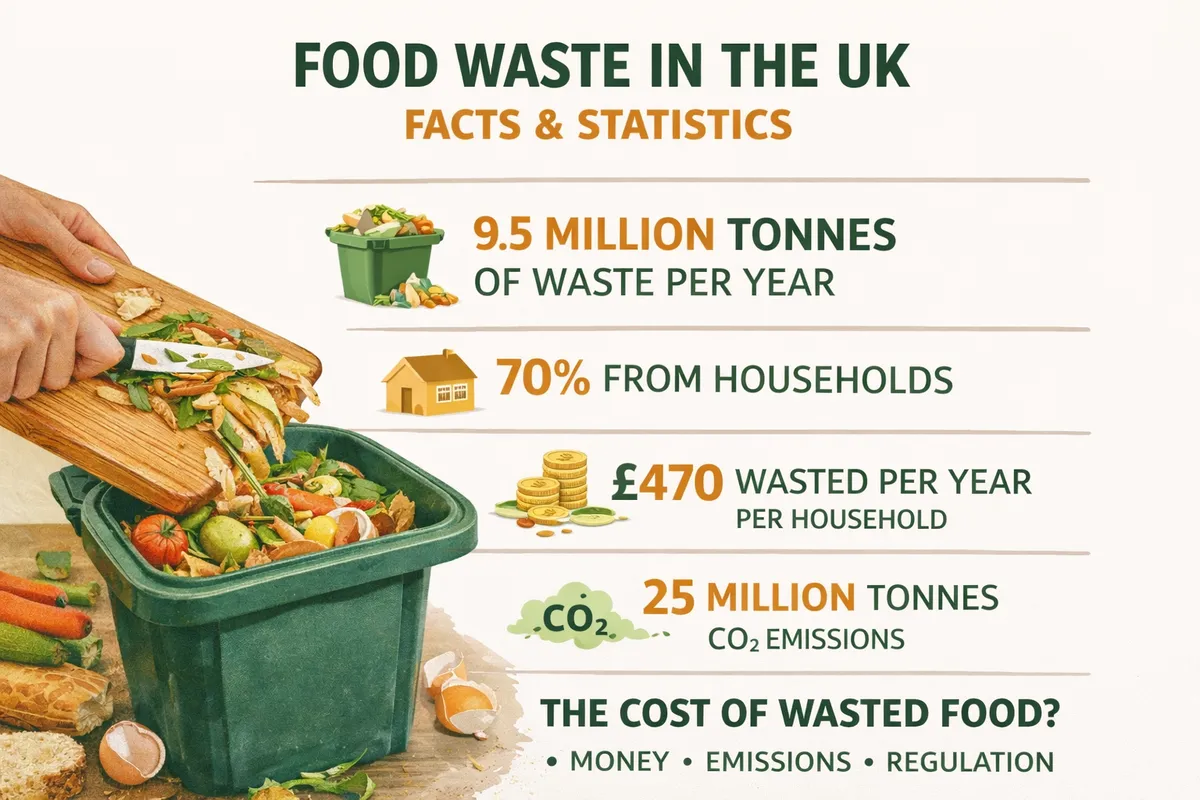
- The UK generates approximately 9.5–9.6 million tonnes of food waste annually.
- Of this total, around 6.4–6.7 million tonnes (roughly two-thirds) is considered edible at the point of disposal.
- UK household food waste alone is estimated to be worth £14–£15 billion per year.
- The average UK household wastes food costing around £470 annually.
- An estimated 8.4 million people in the UK experience food insecurity, while edible food equivalent to tens of millions of meals is discarded each year.
- Food waste is responsible for around 25 million tonnes of CO₂-equivalent emissions annually in the UK, largely due to methane released when waste decomposes in landfill.
Where Does UK Food Waste Come From?
According to WRAP (Waste & Resources Action Programme), food waste in the UK breaks down as follows:
- Households: ~70% (around 6.6–6.7 million tonnes)
- Manufacturing & processing: ~16%
- Hospitality & food service: ~12%
- Retail (including supermarkets): ~2%
Households remain the single largest contributor, despite years of consumer-focused reduction campaigns.
Common Examples of Food Waste
Food waste occurs at every stage of the supply chain, including:
- Plate waste from unfinished meals
- Food discarded due to confusion over date labels
- Vegetable peelings, trimmings, and preparation waste
- Unsold supermarket stock
- Overstocked or poorly managed inventory
- Spoiled food caused by incorrect storage
- Unharvested crops left in fields
- Produce rejected for cosmetic reasons
- Leftovers that are not reused or frozen
How Much Food Waste Does the UK Produce Each Year?
The most widely cited estimate places UK food waste at around 9.5 million tonnes per year.
This figure includes waste generated across:
- Agriculture
- Manufacturing
- Distribution
- Retail
- Hospitality
- Households
While annual totals fluctuate slightly, the overall volume has remained stubbornly high over the last decade.
Most Wasted Foods in the UK
WRAP and industry analyses consistently identify the following among the most wasted food items:
- Bread – around 900,000 tonnes annually
- Potatoes – approximately 700,000–750,000 tonnes
- Milk – around 490,000 tonnes
- Bananas – roughly 190,000 tonnes
- Salad & leafy vegetables – around 170,000 tonnes
These foods are frequently wasted due to short shelf lives, over-purchasing, and poor storage.
Why Does the UK Waste So Much Food?
Key drivers include:
- Overproduction across farming and manufacturing
- Cosmetic standards rejecting edible produce
- Confusion over “best before” vs “use by” labels
- Overbuying and poor meal planning
- Inadequate storage at home and in businesses
- Retail promotions encouraging excess purchases
- Limited redistribution infrastructure
WRAP estimates that better planning, storage, and labelling understanding alone could prevent millions of tonnes of waste each year.
Food Waste Targets in the UK
- The UK has committed to halving food waste by 2030, in line with UN Sustainable Development Goal 12.3.
- An interim government ambition aims for a 20% reduction by 2025, though progress remains uneven.
- WRAP continues to advocate for stronger regulation and mandatory reporting to accelerate change.
Food Waste Legislation (UK)
Following the Environment Act 2021, new requirements are being phased in:
- Businesses in England will be required to separate food waste from general waste, preventing disposal to landfill.
- Scotland and Northern Ireland already require food waste separation for businesses producing over 5kg per week.
- Wales is implementing similar mandatory separation requirements.
The long-term goal is to eliminate food waste to landfill and increase recycling through anaerobic digestion and composting.
Restaurant & Hospitality Food Waste
- The hospitality sector generates around 900,000–1 million tonnes of food waste per year.
- This represents roughly 10–12% of total UK food waste.
- Plate waste alone can account for up to 40% of food served in some settings.
- Food waste costs the UK hospitality sector hundreds of millions of pounds annually in lost stock and disposal costs.
Industry campaigns such as Guardians of Grub aim to cut hospitality food waste by 50% by 2030.
Supermarket Food Waste
- UK retailers generate approximately 200,000–270,000 tonnes of food waste per year.
- Supermarkets redistribute tens of thousands of tonnes of surplus food annually, but this still represents a small proportion of total surplus.
- Only around 7% of surplus food from retail and manufacturing is currently redistributed for human consumption.
Major UK supermarkets have committed to halving food waste by 2030, but independent reporting shows progress varies significantly by retailer.
Should You Trust Food Date Labels?
- Use by: Safety-critical; food should not be eaten after this date
- Best before: Quality-based; food is often safe beyond this date
- Sell by: Retail stock-control label, not a safety indicator
WRAP estimates that misunderstanding date labels causes millions of tonnes of avoidable household food waste each year.
Reducing Food Waste: What Works
For Businesses
- Waste audits
- Better stock forecasting
- Portion control
- Surplus redistribution partnerships
- Staff training
- Food waste recycling
For Households
- Meal planning
- Proper storage
- Freezing surplus food
- Understanding date labels
- Using leftovers creatively
Sources & References
- WRAP (Waste & Resources Action Programme) – UK Food Waste Statistics
- Department for Environment, Food & Rural Affairs (DEFRA)
- Environment Act 2021
- UN Food and Agriculture Organization (FAO)
- Sustainable Restaurant Association / Guardians of Grub
Food safety is preventable with the right training. Our RoSPA-accredited courses start at £13.99 with an instant certificate.
Browse courses → ← All articles