
Eating disorder statistics
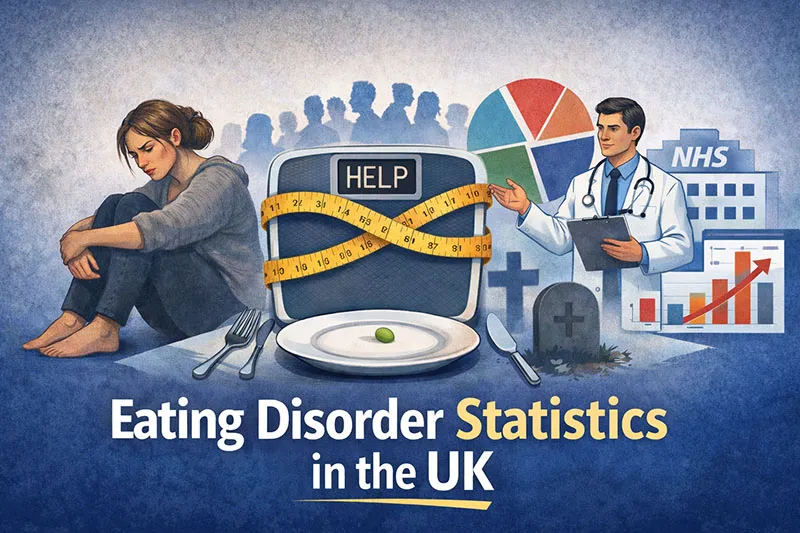
Eating disorders are serious and often life-threatening mental health conditions that can affect people of any age, gender, or background. They are frequently linked with both physical health complications and other mental health conditions, and many people experience long delays before receiving appropriate support. As prevalence continues to rise, eating disorders represent a growing public health concern across the UK.
To provide a clearer picture of the scale and impact of eating disorders, the statistics below bring together evidence from leading UK charities, NHS data, NICE guidance, and peer-reviewed research.
Prevalence
- Estimates suggest that at least 1.25 million people in the UK are affected by eating disorders. [1]
- Wider indicators show that up to 6.4% of adults display some signs of an eating disorder. [2]
- Around 25% of people living with eating disorders are male. [2]
- Disordered eating, which is a known risk factor for developing an eating disorder, is reported in 22.4% of children and adolescents, rising to 31% of adults in the UK. [4]
These figures highlight that eating disorders are far more common than many people realise. A significant number of individuals may experience symptoms without ever receiving a formal diagnosis, particularly adults and men, who are often underrepresented in treatment services.
Impact on health services
- Between 2015 and 2021, hospital admissions for eating disorders increased by 84%, with children and young people being the most affected group. [3]
- In 2020/21, almost half of all hospital admissions for eating disorders involved people aged 25 or younger. [3]
- The 2019 NHS Health Survey reported that 16% of UK adults and 4% of emergency-screened patients screened positive for an eating disorder. [5]
Rising admission rates place increasing pressure on NHS services, particularly child and adolescent eating disorder teams. Many services report difficulty meeting demand, contributing to long waiting times and delayed access to care.
People seeking professional treatment
- Research suggests that individuals with higher levels of shame are more likely to engage in more severe disturbed eating behaviours. [6]
- On average, people wait three-and-a-half years between becoming unwell and starting treatment. [7]
- Binge Eating Disorder (BED) is now recognised as the most common eating disorder, affecting 1 in 50 people in the UK, with an estimated 40% of those affected being male. [8]
- 58% of people with an eating disorder are reported to have at least one psychiatric comorbidity, such as anxiety, depression, or obsessive-compulsive disorder. [9]
Delays in treatment are associated with poorer outcomes, which makes early identification and access to specialist support especially important.
Mortality and outcomes
- Anorexia nervosa is reported to affect up to 3% of young women and has the highest mortality rate of any psychiatric disorder. [10]
- Approximately 5% of patients are reported as dying within four years of diagnosis. [10]
These figures reflect both the physical risks associated with eating disorders and the importance of timely, specialist intervention.
Family history and risk factors
- The most reliable studies suggest that over 50% of the risk of developing an eating disorder may be linked to genetic factors. [11]
- People with a positive family history of eating disorders are reported to have a 7 to 12 times higher risk of developing an eating disorder themselves. [12]
Genetics alone do not cause eating disorders, but they can increase vulnerability, particularly when combined with environmental, psychological, and social factors.
Trends
- During the Covid-19 pandemic, NHS child and adolescent eating disorder services reported that urgent and routine referrals almost doubled. [13]
- Avoidant/restrictive food intake disorder (ARFID) is a relatively newer diagnosis and is estimated to affect between 0.3% and 17.9% of people, depending on the population studied. [14]
- People with autism or ADHD are more likely to experience ARFID than neurotypical individuals, and the condition often begins earlier in life than other feeding and eating disorders. [14]
What these eating disorder statistics tell us
Taken together, these figures show that eating disorders are widespread, frequently underdiagnosed, and often identified late. Young people are being referred in increasing numbers, while many adults live with symptoms for years before accessing help. The data also highlights the need for greater awareness of eating disorders among men and neurodivergent individuals, who may present differently and are less likely to seek support early.
Frequently asked questions about eating disorders
How common are eating disorders in the UK?
At least 1.25 million people in the UK are estimated to be affected, with many more experiencing disordered eating behaviours without a formal diagnosis.
Are eating disorders increasing?
Yes. Hospital admissions increased by 84% between 2015 and 2021, and referrals to child and adolescent services rose sharply during Covid-19.
Which eating disorder has the highest mortality rate?
Anorexia nervosa is associated with the highest mortality rate of any psychiatric disorder.
How long do people wait for eating disorder treatment?
On average, people wait around three-and-a-half years between becoming unwell and starting treatment.
Are eating disorders genetic?
Research suggests that over 50% of risk may be linked to genetic factors, although environment and life experiences also play a major role.
Are men affected by eating disorders?
Yes. Around 25% of people with eating disorders are male, and in Binge Eating Disorder, men are estimated to make up around 40% of those affected.
How these statistics were sourced
The statistics on this page are drawn from a combination of UK charities, NHS surveys, NICE guidance, and peer-reviewed academic research. Prevalence estimates can vary due to differences in diagnostic criteria, screening tools, and levels of underreporting, meaning the true number of people affected may be higher than recorded figures suggest.
If you or someone you care about is affected
Eating disorders are serious but treatable conditions. Early assessment and specialist support can significantly improve outcomes and reduce the risk of long-term physical and psychological harm. If you’re concerned about yourself or someone else, seeking professional advice is an important first step.
Sources
- https://www.beateatingdisorders.org.uk/get-information-and-support/about-eating-disorders/how-many-people-eating-disorder-uk/
- https://www.beateatingdisorders.org.uk/media-centre/eating-disorder-statistics/
- https://www.good-thinking.uk/news/challenging-misconceptions-to-beat-eating-disorders
- https://link.springer.com/article/10.1007/s40519-023-01600-0
- https://digital.nhs.uk/data-and-information/publications/statistical/health-survey-for-england/2019
- https://www.sciencedirect.com/science/article/abs/pii/S0005796723001298
- https://beat.contentfiles.net/media/documents/delaying-for-years-denied-for-months.pdf
- https://www.amh.org.uk/the-facts-and-figures-show-the-scale-of-binge-eating-disorder/
- https://pmc.ncbi.nlm.nih.gov/articles/PMC9442924/
- https://pmc.ncbi.nlm.nih.gov/articles/PMC8429328/
- https://pmc.ncbi.nlm.nih.gov/articles/PMC3010958/
- https://cks.nice.org.uk/topics/eating-disorders/background-information/causes-risk-factors/
- https://pmc.ncbi.nlm.nih.gov/articles/PMC9765325/
- https://beat.contentfiles.net/media/documents/ARFID_Brief_Evidence_Review_for_EDAW_24_l1oDdT5.pdf
Food safety is preventable with the right training. Our RoSPA-accredited courses start at £13.99 with an instant certificate.
Browse courses → ← All articles